ML engineer and researcher · Stanford MS CS, AI and Systems

Hiva Mohammadzadeh

I am a Masters student in Computer Science at Stanford University with Artificial Intelligence and Systems specialization and a graduate of Electrical Engineering and Computer Sciences at UC Berkeley.

Previously, I spent over two years as a Machine Learning Researcher at the PALLAS Group at Berkeley Artificial Intelligence Research Lab (BAIR), advised by Professor Kurt Keutzer.

Currently, I am working as a Machine Learning Engineer at IntuigenceAI, where I finetune synthetic Engineering models and design and deploy multi-agent LLM systems for industrial applications.

My research focuses on efficient deep learning, particularly for Large Language Models. I am interested in KV cache quantization, speculative decoding, and building scalable AI agent systems. I have published at venues including ACL, NeurIPS, and COLM. I enjoy working at the intersection of algorithms and systems, turning research into tools people use.

Portrait of Hiva Mohammadzadeh Stanford, CA

News

what I have been up to
  1. new
    Releasecxpeer 0.5.0 adds a context meter that shows every peer's live prompt size and a --lean mode for spawning peers. New landing page at hivam.org/cxpeer.
  2. ProjectReleased cxpeer, which makes Codex CLI sessions show up as Claude Code peers: event-driven messaging between the two agents, no daemon, no polling.
  3. PaperWho Needs Every Token?, our MrBERT work on learned token deletion for subword transformers, was accepted at the COLM 2026 Efficient Reasoning workshop: 1.89x faster inference on an A100 at 30% deletion with 0.27 points of SNLI accuracy lost.
  4. ProjectsThree Stanford projects wrapped: a dual-precision MX datapath for RLHF quantization on FPGAs (CS217), physically grounded world models for video generation with RLHF and DPO (CS234), and MrBERT, dynamic token merging for encoder-only transformers (CS224N). Details under Projects.
  5. EducationStarted the MS in Computer Science at Stanford, AI and Systems specialization.
  6. PaperSqueezed Attention, accelerating long-context LLM inference, appeared at ACL 2025.
  7. PaperKVQuant, KV cache quantization toward 10-million-token context, presented as a poster at NeurIPS 2024.
  8. RoleJoined IntuigenceAI as a machine learning engineer, building multi-agent LLM systems for industrial applications.
  9. AwardThird place at SCET's Collider Cup XIII for TensorZipper, a model compression algorithm. SPEED appeared at the ENLSP workshop, NeurIPS 2023.

Selected work

All projects
start here, this one is new
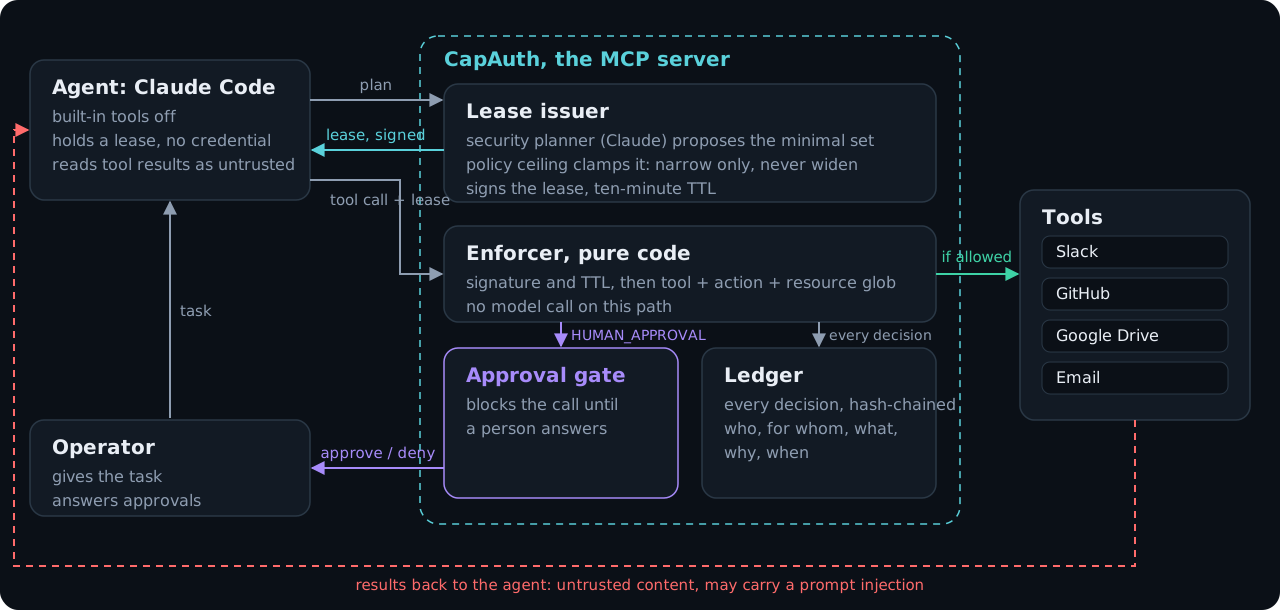
cxpeer: a loop between a Claude session, a bridge, and a Codex session
2026 · open source · Python

cxpeer

Codex CLI sessions as Claude Code peers. A Claude session sends a task with SendMessage, Codex works in its own context, and the answer comes back when the turn ends. Built on Claude Code's undocumented peer registry and Codex's hooks: three files, one Unix socket, no daemon. Includes a context meter that reads each session's live prompt size from the transcripts both tools write.

Claude CodeCodex CLIagent systemsUnix sockets
Landing page and demo
Stanford CS153 · 2026 · Python, LoRA, FastAPI

Memex: an interview simulator for ML-systems engineering

A staff-engineer AI judge runs design interviews and production incidents against a hire bar, a persistent learner model tracks every concept, and a fine-tuned router picks the tutor's context under a token budget. The router was trained as LoRA on four Qwen2.5 sizes on a 32-GPU H100 cluster; the 7B one matches the frontier oracle's selection at 0.81 Jaccard.

context routingfine-tuningagents
Stanford CS349D · 2026 · Python, PyTorch

MiniEngine: a small LLM serving engine

An OpenAI-compatible serving engine in the spirit of mini-sglang: a bare-bones Qwen3 in pure PyTorch with GQA, RoPE, and SwiGLU, prefill and batched decode, top-k and top-p sampling, an SSE-streaming FastAPI server, and a scheduler written to be the optimization target.

inference systemsschedulingserving
Stanford CS329A · 2025 · Python

Self-evolving agents with a reasoning memory

An implementation of ReasoningBank: a ReAct agent with browser tools that extracts reasoning strategies from its own trajectories, stores them in an embedding memory bank, and retrieves them for new tasks. Includes an LLM judge for trajectories and an evaluation harness for WebArena, SWE-bench, and Mind2Web.

agent memoryself-improvementevaluation
Stanford CS217 · 2026 · Verilog, FPGA

Dual-precision MX datapath for RLHF on FPGAs

An FPGA datapath with runtime-selectable microscaling formats for energy-efficient RLHF training. Profiling all 169 quantizable layers of Qwen2.5-0.5B showed 93.5% tolerate MXFP4; the rest fall back to MXFP8.

FPGAquantizationRLHF

Publications

Google Scholar
  1. Who Needs Every Token? Adapting Dynamic Token Merging to Subword-level Transformers

    Aronima Dass, Alina Tianhui Huang, Hiva Mohammadzadeh

    COLM 2026, Efficient Reasoning workshop
  2. Squeezed Attention: Accelerating Long Context Length LLM Inference

    Coleman Hooper*, Sehoon Kim*, Hiva Mohammadzadeh, Monishwaran Maheswaran, June Paik, Michael W. Mahoney, Kurt Keutzer, Amir Gholami

    ACL 2025
  3. KVQuant: Towards 10 Million Context Length LLM Inference with KV Cache Quantization

    Coleman Hooper, Sehoon Kim, Hiva Mohammadzadeh, Michael W. Mahoney, Yakun Sophia Shao, Kurt Keutzer, Amir Gholami

    NeurIPS 2024
  4. SPEED: Speculative Pipelined Execution for Efficient Decoding

    Coleman Hooper, Sehoon Kim, Hiva Mohammadzadeh, Hasan Genc, Kurt Keutzer, Amir Gholami, Sophia Shao

    ENLSP workshop, NeurIPS 2023
  5. Plume-induced delamination initiated at rift zones on Venus

    Andrea Adams, Dave Stegman, Hiva Mohammadzadeh, Suzanne Smrekar, Paul Tackley

    Journal of Geophysical Research: Planets, 2023

Education

Experience

Work
Research
Awards
Skills

Projects

GitHub

Get in touch

Open to research collaborations, questions about the work above, and conversations about efficient inference and agent systems.